huawei's sic tech tackles nvidia's ai heat challenge
Shenzhen, Friday, 19 September 2025.
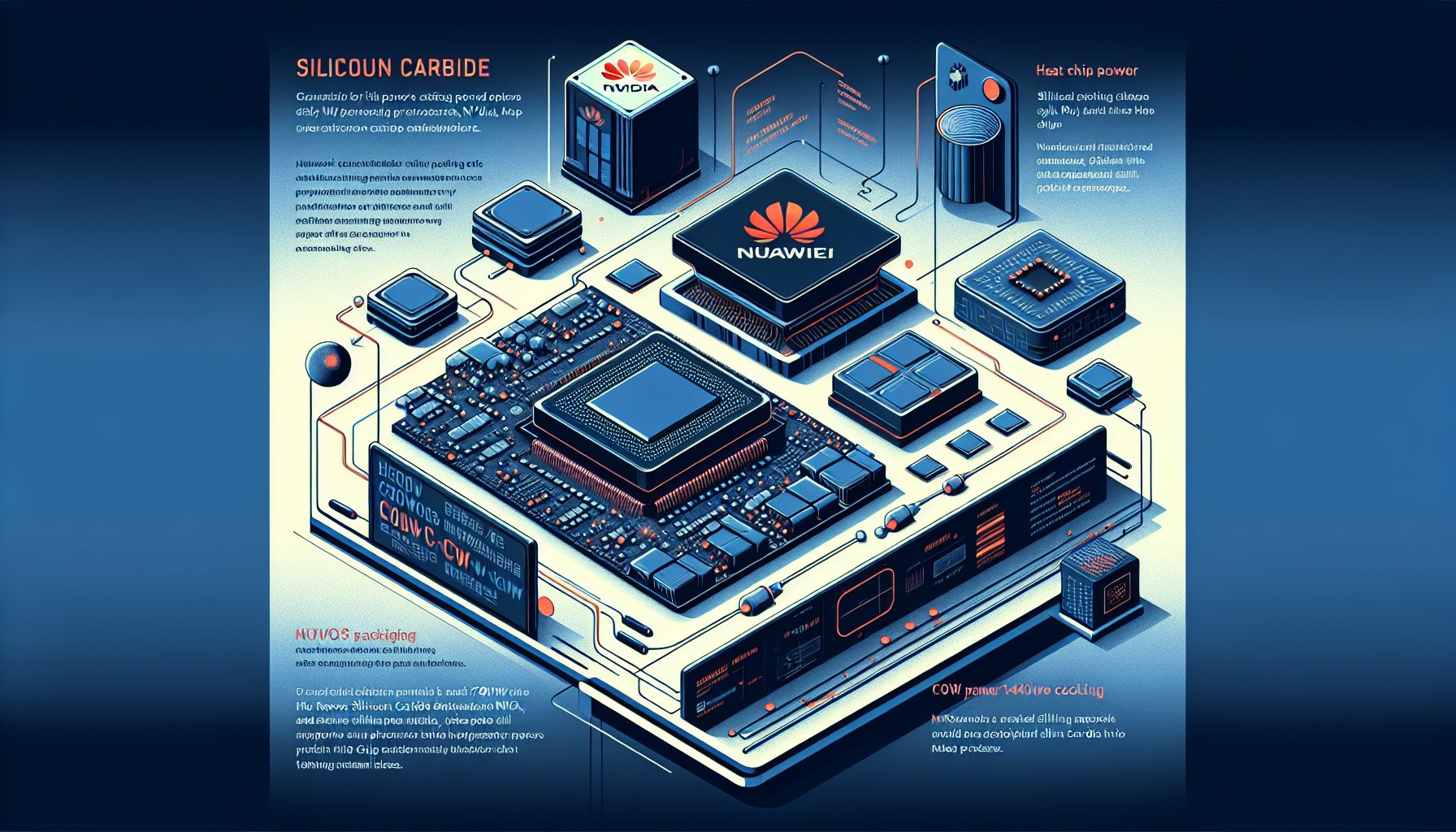
huawei is innovating silicon carbide cooling solutions to combat the rising heat in high-power AI chips. nvidia’s gpu chip power jumped from 700w (h200) to 1400w (b300). this increase underscores the need for better cooling. huawei’s approach targets thermal issues in cowos packaging, which combines chips. notably, nvidia plans to use silicon carbide in its rubin processors by 2027. huawei’s advance could reshape ai system efficiency.
silicon carbide properties and advantages
Silicon carbide’s superior thermal conductivity is key to its appeal [1][4]. It boasts a thermal conductivity of 500 W/mK, significantly outperforming silicon at 150 W/mK and ceramic substrates ranging from 200 to 230 W/mK [1][2][4]. Furthermore, silicon carbide’s thermal expansion coefficient closely matches chip materials [1][2]. This compatibility ensures efficient heat dissipation and stable packaging [1][2]. The use of silicon carbide can lower gpu chip junction temperatures by 20°C to 30°C, reducing cooling costs by 30% [1][2]. It also prevents chips from overheating and reducing frequency, thereby maintaining stable computing power [1][2].
nvidia’s strategic shift and market impact
Nvidia’s potential adoption of silicon carbide in its Rubin processors signals a major shift [1][4]. The company plans to replace silicon with silicon carbide in the CoWoS advanced packaging interposer [1][2][4]. This change is projected to occur on a large scale by 2027 [1][2][4]. Oriental Securities suggests that using silicon carbide interposers could significantly reduce heatsink size and optimize overall packaging [1][2]. Such a move could provide nvidia with a competitive edge in delivering high-performance ai solutions [GPT].
huawei’s patent strategy
Huawei’s recent patents highlight its focus on silicon carbide thermal management [1][4]. These patents include “Thermal Conductive Composition and Preparation Method and Application” and “A Thermal Conductive Wave-Absorbing Composition and Application” [1][4]. Both patents utilize silicon carbide as a filler to enhance the thermal conductivity of electronic devices [1][4]. One patent focuses on heat dissipation for electronic components and packaged chips, while the other targets electronic components and circuit boards [1][4]. Huawei’s proactive approach could establish it as a key player in silicon carbide cooling technology [GPT].
a-share market response
The a-share market has responded positively to nvidia’s interest in silicon carbide cooling [1][2]. Several related stocks have seen substantial gains since september [1][2]. Lu Xiao Technology and Tianyue Advanced have both experienced gains exceeding 30% [1][2]. Jingsheng Electromechanical and TianTong shares have risen by over 20% [1][2]. Tianfu Energy and In Tang Zhikong have also seen increases of more than 10% [1][2]. This surge reflects investor confidence in the potential of silicon carbide technology [GPT].
industry involvement and expansion
Several companies are expanding their silicon carbide capabilities [1][4]. Tianyue Advanced is expanding into emerging fields such as optical waveguides and heat dissipation components [1][4]. Sanan Optoelectronics is advancing the application of silicon carbide substrates in ai/ar glasses and heat sinks [1][4]. Jingsheng Electromechanical has achieved a breakthrough in 12-inch conductive silicon carbide single crystal growth technology [1][2]. These developments indicate a broadening scope for silicon carbide applications beyond traditional power electronics [1][2].
financial analysis and investment trends
Multiple silicon carbide concept stocks have seen increased financing since september [1][2]. Tongfu Microelectronics, Lusxiao Technology, Tianyue Advanced, Intang Zhikong, and Tontong shares have each received over 300 million yuan in increased investment [1][2]. Tongfu Microelectronics saw the largest increase, reaching 701 million yuan, with a new financing balance of 2.634 billion yuan [1][2]. Lusxiao Technology received an increase of 416 million yuan, bringing its latest financing balance to 1.327 billion yuan [1][2]. These investments highlight strong financial backing for silicon carbide ventures [GPT].