eu forms chip alliance: can europe regain semicon power?
Brussels, Friday, 14 March 2025.
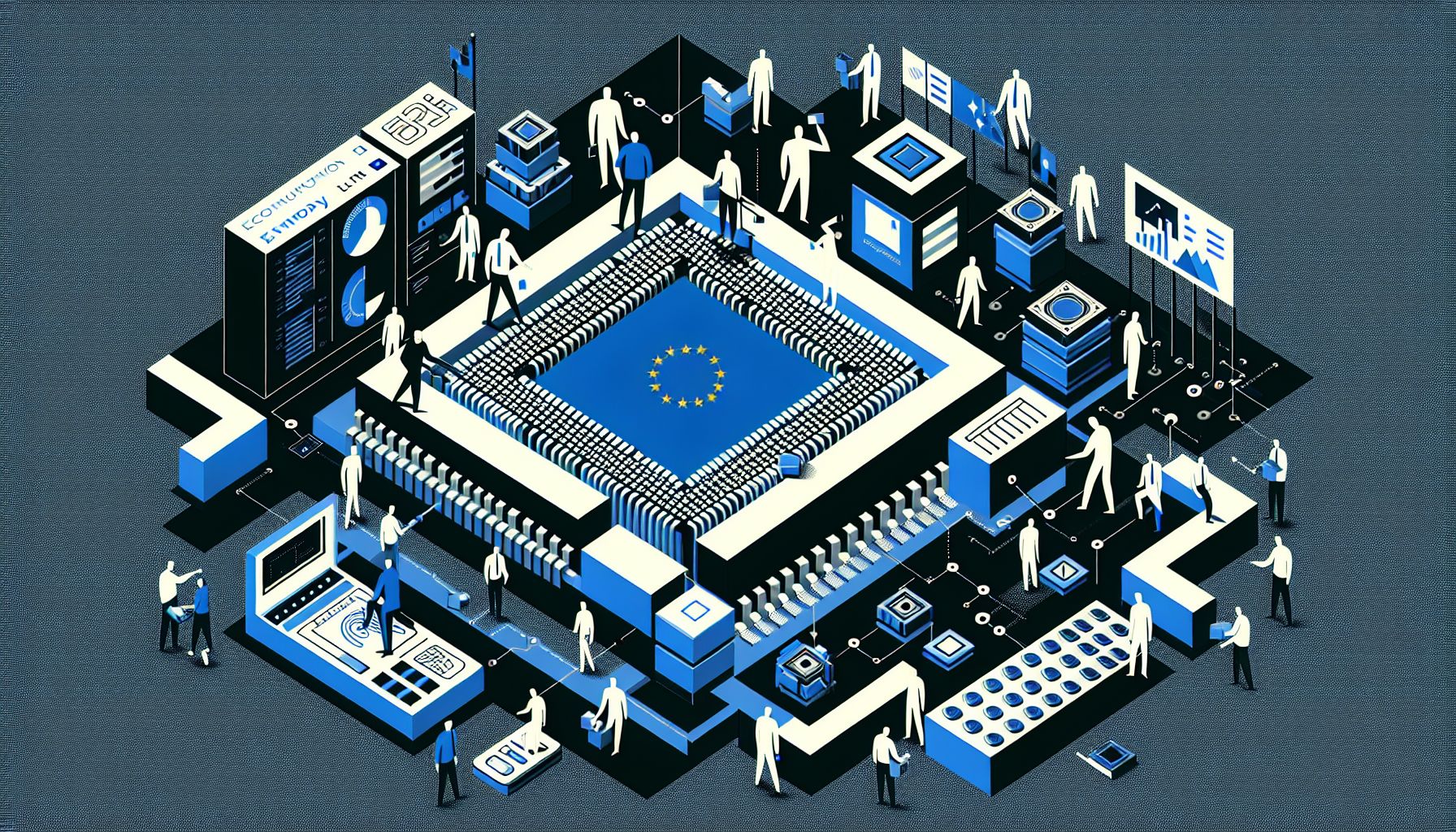
Nine EU nations have banded together to form the Semicon Coalition. This alliance seeks to boost Europe’s chip production and reduce reliance on foreign suppliers. The goal is to enhance technological sovereignty. The EU hopes to compete with the United States and Asia. This initiative comes as projections estimate a $2 trillion impact across all industries by 2030 due to AI. Europe must implement key strategies by 2027 to remain competitive in the AI revolution. Will this be enough to challenge global leaders like ASML?
coalition details
The Semicon Coalition, launched on March 12, 2025, includes Austria, Belgium, Finland, France, Germany, Italy, Poland, Spain, and the Netherlands [1][5][7]. Led by the Netherlands, the coalition aims to increase chip production capacity and invest in research [1][5]. This initiative seeks to reduce reliance on external suppliers and bolster Europe’s strategic autonomy in the semiconductor industry [1]. The European Commission supports the coalition and its goals [3]. The EU hopes to foster an innovative and competitive semiconductor ecosystem [3][7].
chips act and investment
The European Commission is already working with member states through the Chips Act [3]. This act has mobilized over €80 billion in investments for semiconductor manufacturing and research and development [3][7]. The Semicon Coalition will provide valuable insights as the EU evaluates and refines its policies [3]. The coalition plans to invest €50 billion in semiconductor research and manufacturing over the next five years [5]. They also aim to establish two new advanced semiconductor fabrication plants by 2030 [5].
asml’s role and partnerships
ASML, a key player in semiconductor equipment, has signed a five-year strategic partnership with imec to advance semiconductor research and sustainability in Europe [4][6]. This collaboration integrates ASML’s product portfolio into imec’s pilot line [4]. The partnership supports research on sub-2nm technology, silicon photonics, memory, and advanced packaging [4]. This initiative aims to strengthen semiconductor-based AI [4]. These partnerships are crucial for maintaining ASML’s technological leadership [GPT].
market impact and analysis
The formation of the Semicon Coalition and related investments could positively influence ASML’s order book [alert! ‘impact amount not specified’]. Increased demand for advanced chip manufacturing equipment would likely benefit ASML [GPT]. However, the coalition’s goal of reducing reliance on external suppliers could pose a long-term challenge [alert! ‘extent of challenge not specified’]. Strengthening domestic supply chains is vital for Europe’s prosperity and safety [1]. The EU’s focus on automotive and industry 4.0 may require further expansion into connected devices and software [8].
broader industry trends
The global foundry market grew nearly 10% in Q4 2024, reaching $38 billion [6]. TSMC held a 67% market share, with approximately $27 billion in revenue [6]. Intel appointed Lip-Bu Tan as CEO, effective March 18 [4][6]. TSMC pitched NVIDIA, AMD, Broadcom, and Qualcomm on a joint venture to operate Intel Foundry [6]. These developments highlight the dynamic nature of the semiconductor industry [GPT]. Europe’s efforts to increase its semiconductor capacity occur amidst these global shifts [1].
Bronnen
- www.capacitymedia.com
- www.semi.org
- digital-strategy.ec.europa.eu
- www.eetimes.eu
- www.linkedin.com
- semiengineering.com
- ieu-monitoring.com
- www.linkedin.com