china's chip independence drive: betting on duv amid euv access hurdles
Beijing, Tuesday, 23 September 2025.
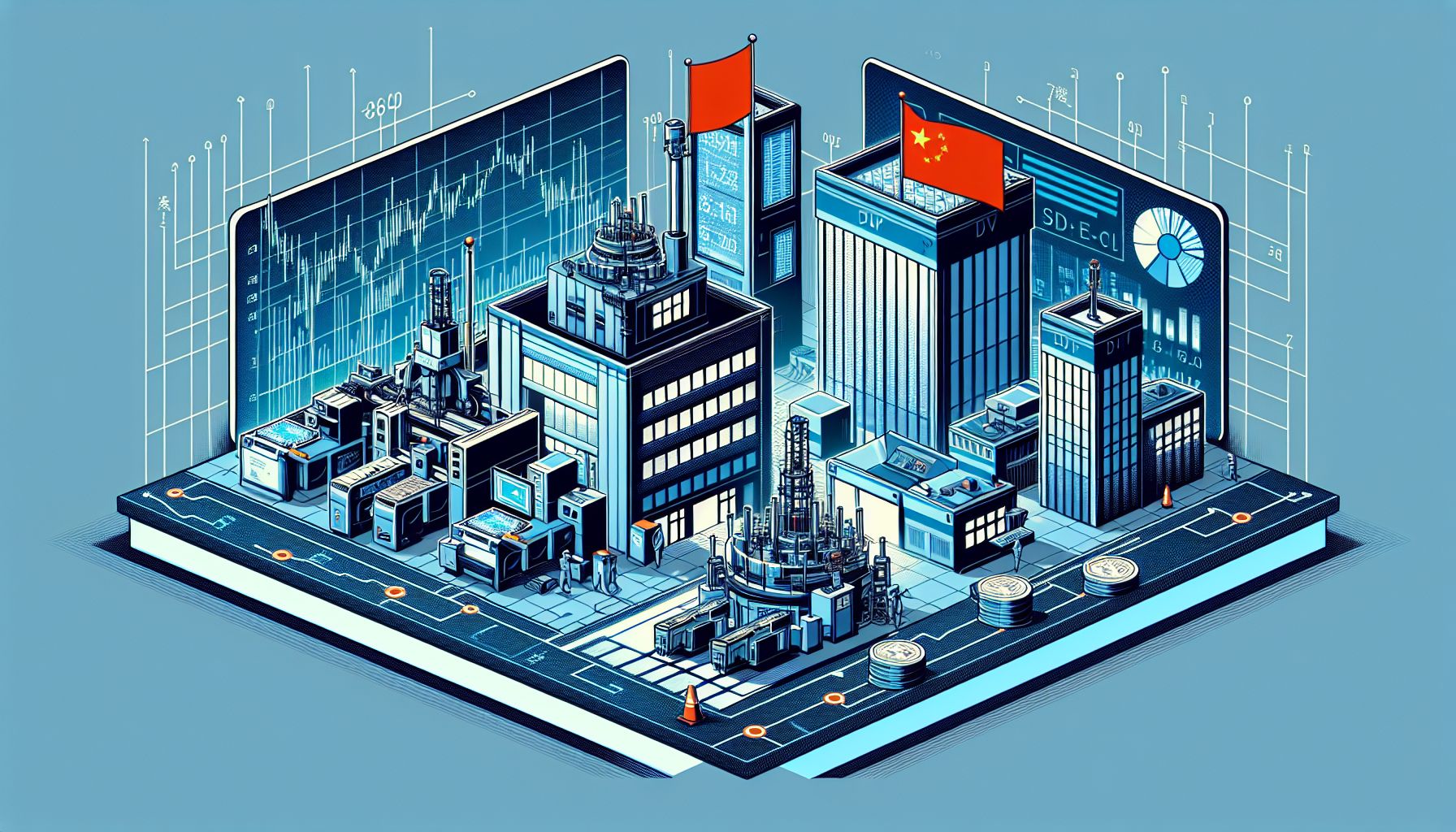
facing restrictions on euv lithography, china is aggressively pursuing duv technology to achieve semiconductor self-sufficiency. this involves significant investment in domestic duv manufacturing and advanced multi-patterning techniques. smic is currently testing duv lithography machines that are designed to produce 7nm chips. while asml’s ceo estimates china is 10 to 15 years behind, this strategy aims to mitigate geopolitical risks and reshape the global chip landscape, potentially impacting asml’s future revenues.
domestic duv development
China’s largest chipmaker, SMIC, is currently testing its first domestically produced deep ultraviolet (DUV) lithography machine [2][7]. This machine was developed by Shanghai Yuliangsheng, a Huawei-linked affiliate of SiCarrier [1]. The DUV lithography machine uses immersion technology similar to ASML systems [2]. Most components are produced domestically, but some critical optical and precision elements still rely on imports [2]. The company is striving for complete domestic production to reduce reliance on foreign export policies [2].
technical capabilities and limitations
The new DUV machine is designed for the 28nm process, a key area for China’s chip production [2]. Using multi-patterning techniques, it can be extended to produce 7nm chips, and potentially even 5nm chips, albeit with lower yields [1][2]. Experts suggest that achieving 7nm or 5nm nodes will lead to decreased yields and increased production costs [2]. This makes the equipment more suitable for research and development rather than immediate mass production [2]. According to outside analysis, the level of the DUV is roughly equivalent to ASML’s Twinscan NXT:1950i from 2008 [7].
market impact and asml’s position
In 2024, nearly half of ASML’s second-quarter equipment tooling shipments went to China [1]. Restrictions imposed since 2022 have blocked exports of EUV and advanced immersion DUV systems, including ASML’s Twinscan NXT:1970i and NXT:1980i [1]. These restrictions are reshaping the chipmaking landscape, with DUV becoming the backbone of China’s homegrown ecosystem [1]. ASML leadership recognized China’s efforts in mastering immersion technology as early as 2018 and 2019 [3]. Despite these advancements, ASML’s CEO maintains that China remains ten to fifteen years behind [1].
huawei’s advancements and future plans
Huawei is making strides in chip development, with its HiSilicon unit generating over 90 billion yuan (approximately $12.6 billion) in revenue in 2024 [6]. This is a substantial increase from $1.5 billion in 2021 740 = 740 % increase] [6]. Huawei’s Ascend 930 AI chip, manufactured using a 7nm process, was announced on September 19, 2025 [6]. The Ascend 930 is designed for data centers and offers improved performance compared to the Ascend 920 [6]. Huawei is also planning to launch the Ascend 1000 series chip by the end of 2026 [6].
investment considerations
SMIC’s testing of domestic DUV lithography machines has driven up Chinese semiconductor stocks [7]. China’s advancements could potentially counter Nvidia’s market dominance [6]. However, experts suggest it will take at least a year of continuous adjustments for the new DUV equipment to reach the stability and yield required for mass production [2]. Analysts estimate the equipment may be integrated into SMIC’s 28nm production line by 2027, with further challenges to 16nm or 7nm possibly delayed until after 2030 [7]. Investors should note that building a fully domestic supply chain could take over 10 years and exceed $1 trillion in costs [3].