brain drain: south korea's chip sector threatened by medical career boom
Seoul, Tuesday, 18 March 2025.
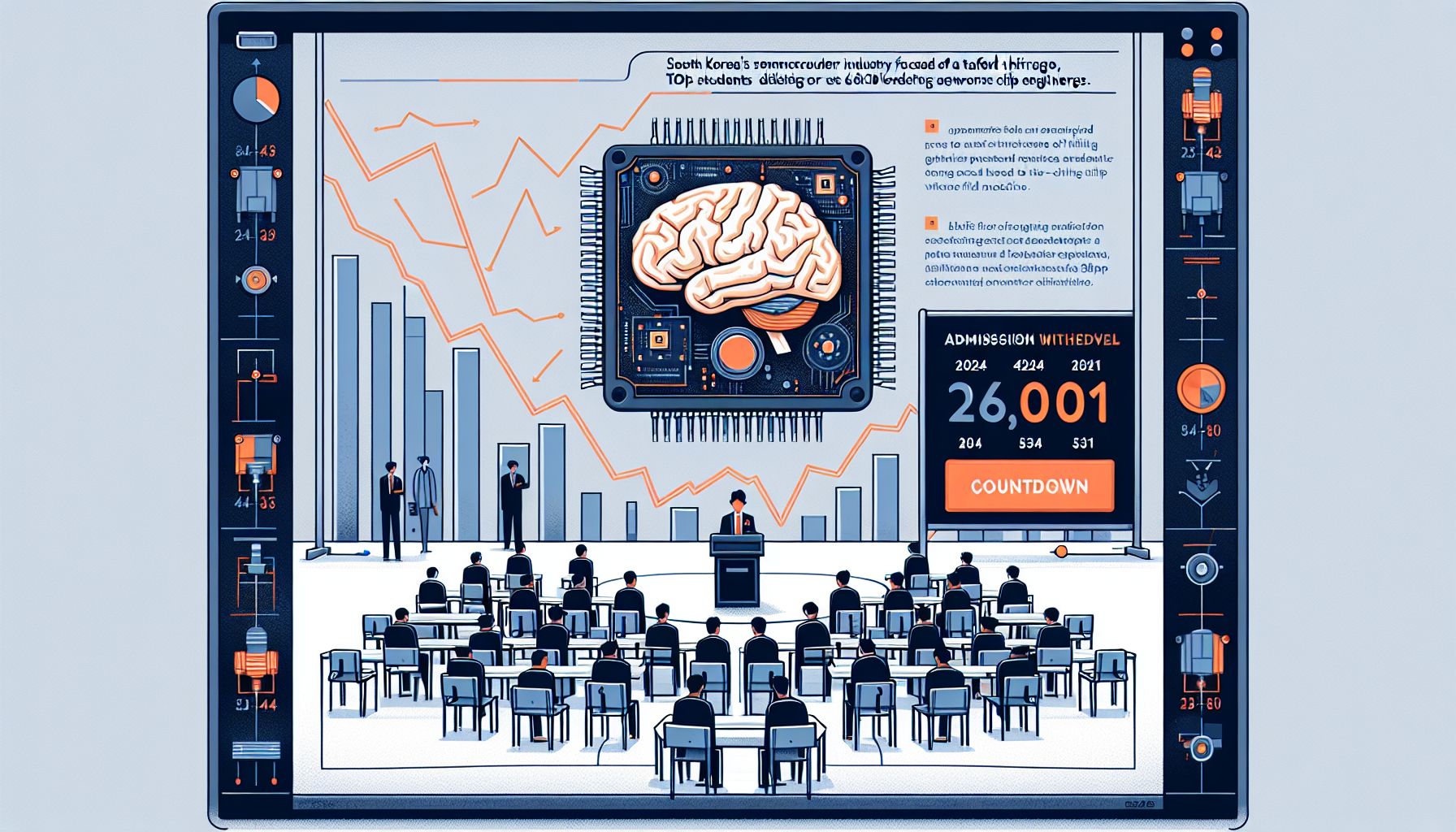
south korea’s semiconductor industry is facing a critical talent shortage. Top students are increasingly choosing medicine over chip engineering. The admission withdrawal rate for top semiconductor programs skyrocketed to 179% in 2024. This shift raises concerns about the nation’s future competitiveness. Critical sectors such as AI and chip manufacturing could be impacted. The ministry estimates a shortfall of 56,000 chip engineers by 2031. This trend could have far-reaching implications for companies like samsung and the broader south korean economy.
talent pool erosion
The shift away from semiconductor careers is evident in declining enrollment rates. Sungkyunkwan University’s semiconductor graduate programs saw enrollment decrease from 17.6% in 2021 to 15.8% in 2023 [1]. This decline signals a weakening pipeline of skilled engineers entering the workforce. Lee Jong-hwan, a system semiconductor engineering professor at Sangmyung University, noted that top talent in South Korea is increasingly drawn to medical schools [1]. This preference impacts the long-term availability of qualified personnel for the semiconductor industry.
investment disparity
South Korea’s investment in AI lags significantly behind its global competitors. Representative Ahn Cheol-soo highlighted that China plans to invest 1,800 trillion won (US$1.24 billion) in AI by 2030, while the U.S. is committing $500 billion to its Stargate Project [1]. In contrast, South Korea’s investment in 2024 was only 1.8 trillion won [1]. Ahn Cheol-soo also pointed out the disparity in AI researchers, with China having 410,000 and the U.S. 200,000, while South Korea has fewer than 20,000 [1]. This disparity raises concerns about South Korea’s ability to compete in the AI sector.
samsung’s struggle
Samsung faces significant challenges, as highlighted by Chairman Lee Jae-yong, who warned executives that the company has lost its competitive edge [6]. Samsung’s foundry division reported operating losses exceeding 2 trillion won ($1.4 billion) in the last quarter of 2024 [6]. The company is also behind SK Hynix in delivering 12-layer HBM3E memory [6]. Samsung’s global market share has declined across multiple sectors. TV market share decreased from 30.1% in 2023 to 28.3% last year. Similarly, smartphone market share fell from 19.7% to 18.3%, and DRAM sector share dropped from 42.2% to 41.5% [6].
labor market dynamics
South Korea is projected to face a broader labor shortage, exacerbating the challenges in the semiconductor industry. A report indicates a potential shortage of 820,000 workers by 2033 [2][3]. The economically active population is expected to increase by only 312,000 between 2023 and 2033, a sharp contrast to the nearly 3.2 million increase in the previous decade [2][3]. The manufacturing sector alone is projected to face a shortage of 123,000 workers by 2033 [2][3]. This situation demands policy interventions to encourage greater labor force participation.
potential remedies and market impact
To mitigate the talent shortage, analysts suggest policy changes to encourage participation from underrepresented groups [2][3]. These include women, older adults, and young people. Improving worker productivity through technological development is another proposed solution [2]. Some suggest increasing the intake of foreign workers to fill the labor void [2][3]. Failure to address these issues could further depress samsung’s stock, which has already underperformed SK Hynix. Samsung’s share price has increased 8% year-to-date, while SK Hynix has seen gains of 20.6% [6].
Bronnen
- e.vnexpress.net
- www.koreatimes.co.kr
- nairametrics.com
- hr.asia
- foreignpolicy.com
- www.kedglobal.com
- www.digitimes.com
- uk.linkedin.com