Asml's china exports take a hit amid us pressure: what's next for the chip market?
Veldhoven, Tuesday, 15 April 2025.
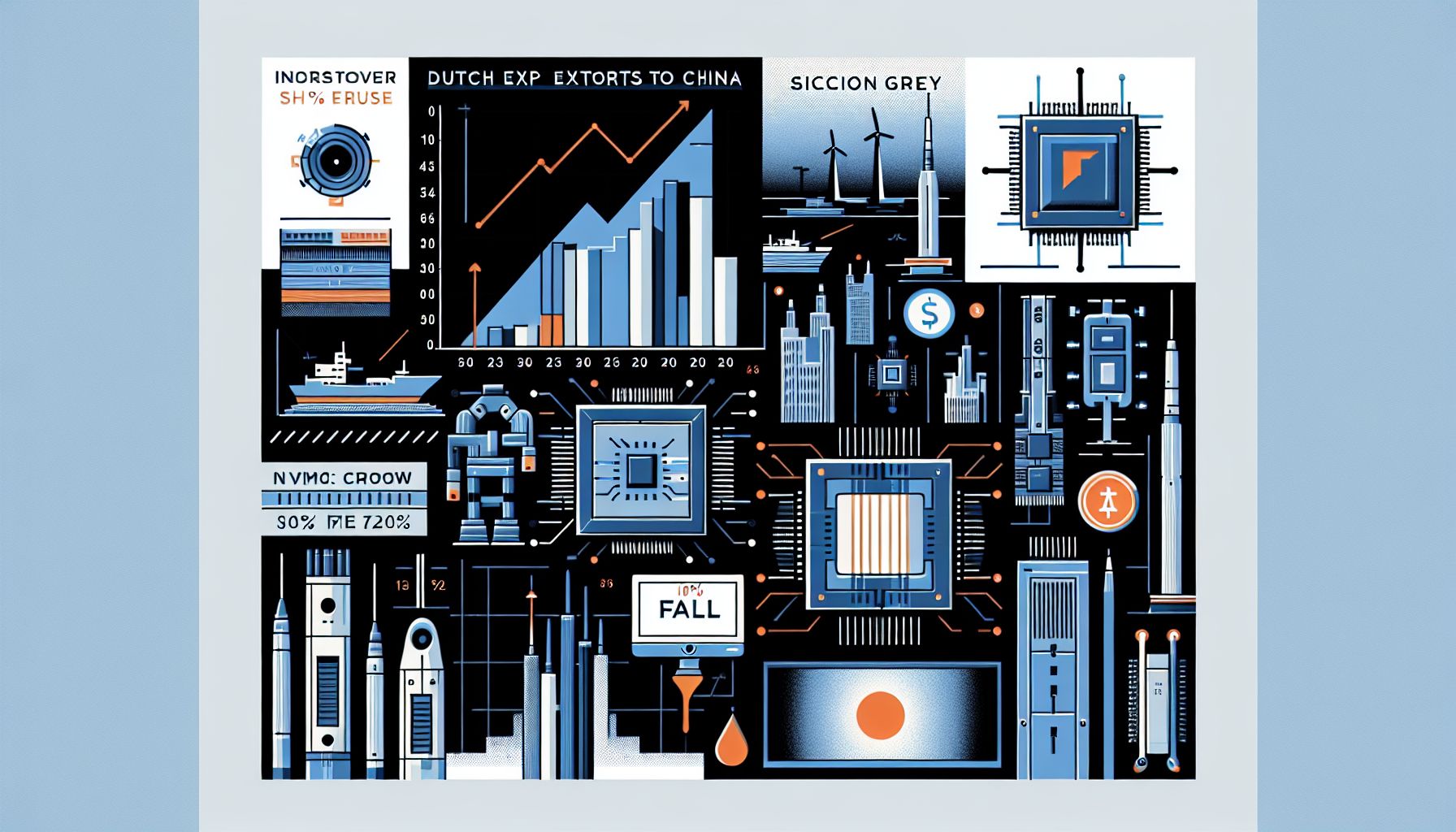
Dutch exports to China experienced a sharp decline of over 10% in March. This follows restrictions on ASML’s sales of advanced semiconductor equipment due to US pressure. Chinese buyers had been stockpiling high-end tools. ASML’s CEO anticipates China’s revenue contribution will normalize in 2025. This shift signals potential changes in the semiconductor landscape and raises questions about future trade dynamics and ASML’s financial performance. The company is slated to report Q1 earnings tomorrow, April 16.
asml’s q1 earnings outlook
ASML is scheduled to release its first-quarter 2025 earnings on April 16 [2]. The company anticipates revenues between €7.5 billion and €8 billion [2]. Current estimates suggest a potential 40.7% increase from the previous year, with the consensus pegged at $8.08 billion [2]. Earnings per share are projected to rise by 81.1% to $6.12, up from $3.38 in the same quarter last year [2]. These upward revisions signal strong financial performance, potentially driven by increased memory demand [2].
market reaction and competitive landscape
Despite positive earnings expectations, ASML’s stock has underperformed, falling 30% over the past year, while the Zacks Computer and Technology industry grew by 2.8% [2]. Competitors like KLA Corporation, Lam Research, and Applied Materials have also experienced declines, with drops of 1.2%, 28.7%, and 29.6% respectively [2]. ASML’s forward 12-month P/E ratio stands at 24.94X, exceeding the sector average of 22.26X [2]. This premium valuation reflects investor expectations but also highlights potential risks amid market volatility [2][3].
us-china trade tensions and asml’s technological edge
US-China trade tensions and export restrictions pose ongoing challenges for ASML [2]. These restrictions aim to slow China’s technological advancements, particularly in semiconductor manufacturing [1]. However, some analysts suggest that these measures may backfire, spurring domestic innovation in China [6]. ASML’s technological leadership remains crucial, with its high-NA EUV systems representing a significant advancement in lithography [7]. Intel has already installed and is utilizing ASML’s high-NA EUV tools for pilot production [7].
china’s response to tech restrictions
China is actively pursuing technological self-reliance in response to export restrictions [6]. This includes developing domestic capabilities in GPUs, chipsets, LLMs, and operating systems [6]. Experts note that Chinese cities boast ultra-modern infrastructure and rapid tech adoption, with AI integrated into various aspects of daily life [6]. Despite trade tensions, there’s a sense of confidence and determination within China to achieve long-term technological progress [6]. This resilience could reshape the global tech landscape, potentially impacting ASML’s future market position [alert! ‘impact is uncertain’] [1].
navigating geopolitical complexities
ASML operates at the intersection of technological innovation and geopolitical strategy. Decisions made by political leaders, such as those regarding tariffs and trade restrictions, can significantly impact the company’s operations and market access [3][4]. The situation remains fluid, with potential for policy shifts and further market volatility [3]. ASML’s ability to navigate these complexities while maintaining its technological edge will be critical for its long-term success. Some analysts suggest cooperation at eye level is the appropriate response [6].
Bronnen
- www.scmp.com
- www.tradingview.com
- www.bbc.com
- www.bloomberg.com
- fortune.com
- www.linkedin.com
- semianalysis.com